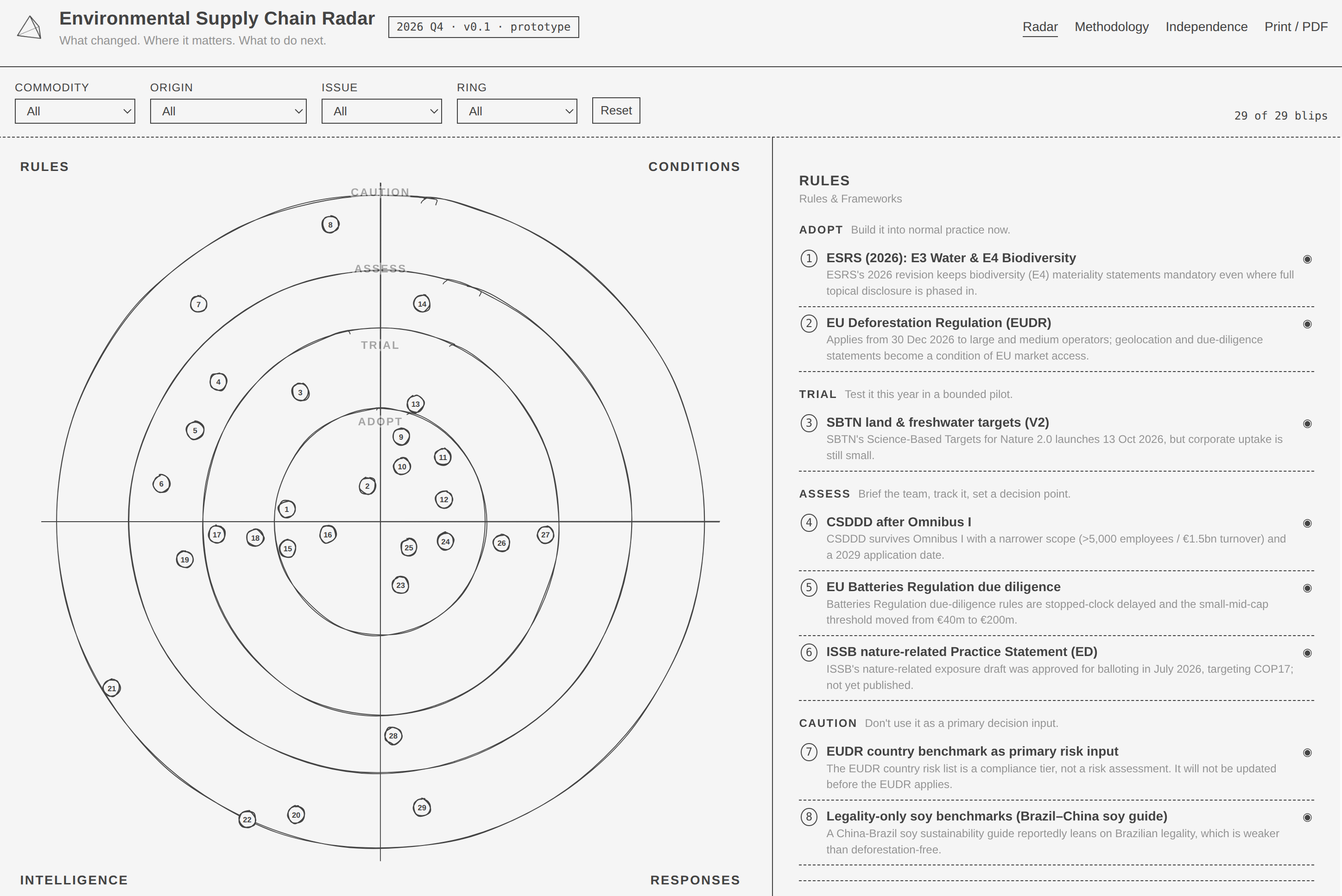
Walter a quarterly decision radar for navigating environmental risk in global supply chains.
 Walter
Environmental risk in commodity supply chains is hard to understand. Regulations are emerging and changing. Climate and ecological conditions are shifting. New satellite, geospatial and AI capabilities are producing more data. Commodity supply chains increasingly intersect with questions of water, forests, biodiversity, land degradation and ecosystem resilience. At the same time, companies, investors and consultants are being asked to turn all of this complexity into practical decisions.
Yet much of the information available today falls into two categories: bespoke consulting reports that become outdated quickly, or generic risk scores and data products that are difficult to translate into action.
Walter, The Environmental Supply Chain Risk Radar fills that gap.
It is a recurring, evidence-linked, opinionated overview of what is changing in environmental supply-chain risk: what matters now, what is becoming important, what is mature enough to use, and what organisations should do next.
The model is inspired by the Thoughtworks Technology Radar: a simple visual language, a recurring publication cadence, and explicit recommendations rather than another passive database.
Methodology
The Radar tells procurement and sustainability-risk leads at EU-connected companies which environmental rules, conditions, tools and methods to act on, trial or watch over the next 1–4 quarters, and for which commodity and origin.
Quadrants
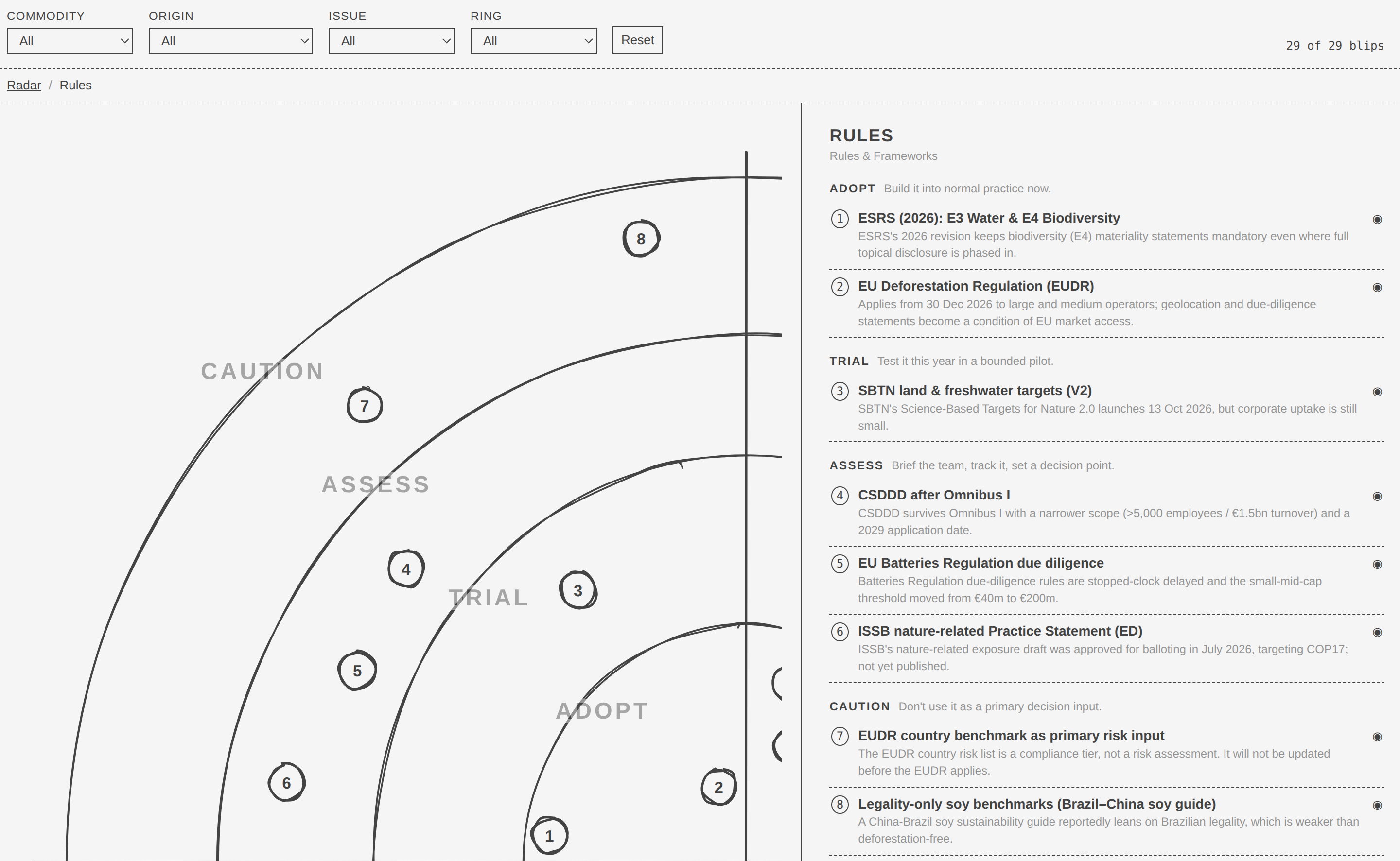
- Rules: Rules & Frameworks: regulations, reporting and disclosure standards, due-diligence regimes, voluntary frameworks.
- Conditions: Environmental Conditions: what is happening in the ecological systems behind supply chains.
- Intelligence: Data & Intelligence: datasets, geospatial layers, monitoring and alert systems, models, platforms.
- Responses: Responses & Methods: methods, practices and approaches organisations can apply.
 rules quadrant
Rings
A ring is a recommended action for the next 1–4 quarters. It never says how severe something is.
- ADOPT: Build it into normal practice now. If you haven’t, you’re behind.
- TRIAL: Test it this year in a bounded pilot with a learning goal.
- ASSESS: Brief the team, track it and set a decision point. No implementation budget yet.
- CAUTION: Don’t use it as a primary decision input. Challenge it, corroborate it, or phase it out.
For Conditions, ADOPT means: factor it into sourcing decisions now.
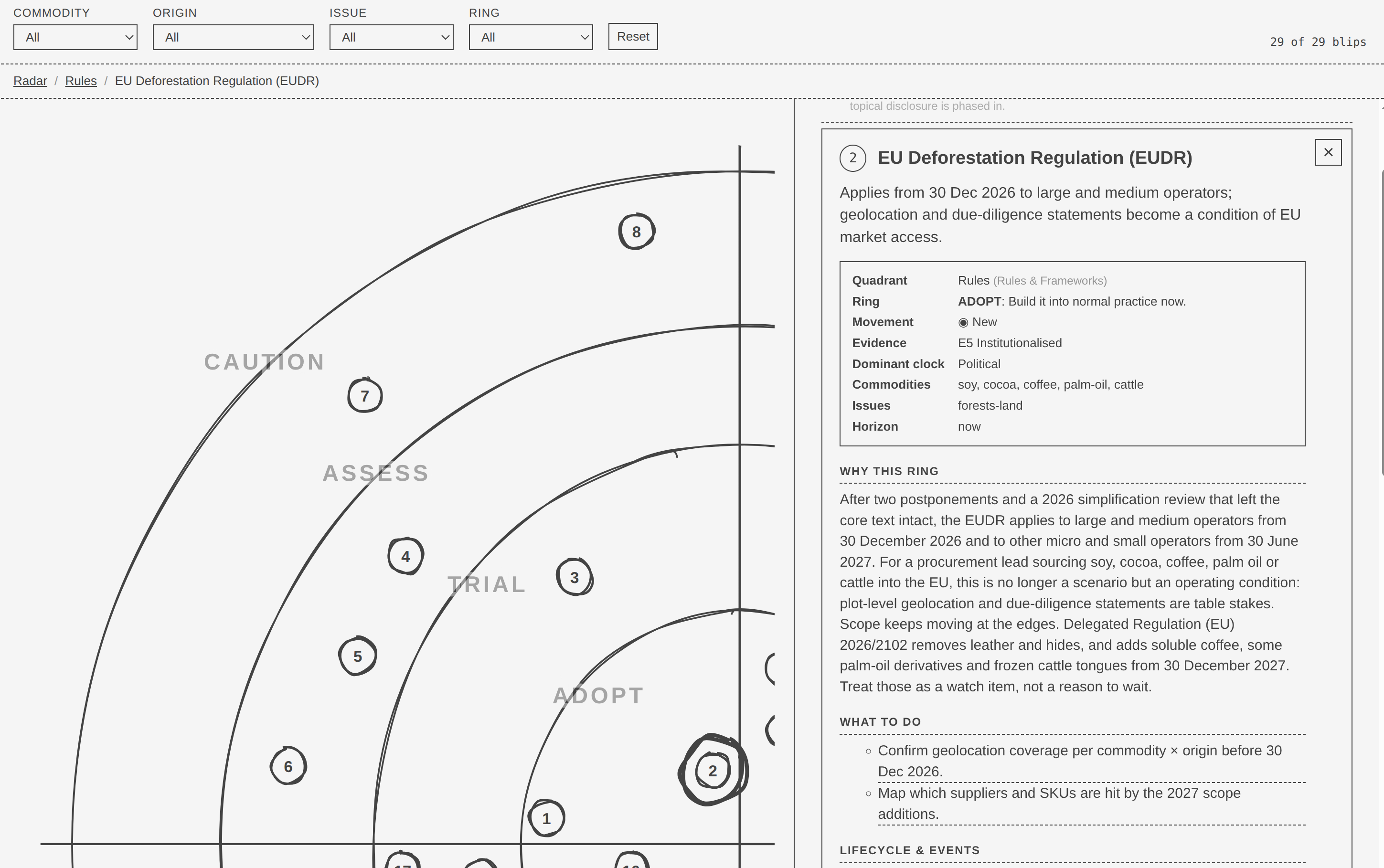
Evidence levels
- E1: Emerging
- E2: Corroborated
- E3: Operational
- E4: Established
- E5: Institutionalised
Only Conditions blips carry a severity (Low / Medium / High). There are no 0–100 scores anywhere.
 EUDR blip details
Editorial method
- Every blip has at least 2 sources. E3 or higher needs at least 1 primary source. ADOPT needs E3 or higher. CAUTION needs a concrete, sourced reason.
- Every ring change comes with a one-line reason that names its evidence.
- A blip is an entity (a rule, condition, tool or method) with a lifecycle. Events such as delays, releases or retirements are recorded on the blip and can move it between rings.
Independence
- No one can pay for inclusion on the Radar or for a better ring.
- If a blip concerns a client or partner of This Hollow Earth, the blip says so.
- Vendor suggestions are welcome, but they go through the same evidence bar as everything else.