Since 2015, I have been intimidated, envious and inspired by Brett Victors bookshelf. I have a list of books to buy called “Brett Victor” and I have always dreamed of having my own bookshelf.
 arjens books
And I had one …
An evening stroll
I was walking my dog the other day when we ran into the koala
“Oh lord please, not a koala”, I thought
“Good morning koala”, I said
“Good morning”, the koala said
“I am from Australia”, the koala said, “Where are you from?”
“Mali”, I said, “I’m from Mali.”
“Mali,” the koala said, his face turning into a question mark, “Mali …”
“Yeah, Mali”, I said
The koala took a bite from the little branch of eucalypt he held in his tiny koala hands
“I’m from Australia”, the koala said
“I’m from Mali”, I thought and walk away
 this is a good record
I wrote about the Jevons paradox before. The latest AI hype poster boy is called (you do not make this up) Jev. The industry becomes self mocking. That could be a sign of maturity or a sign of defeat.
It gives us the opportunity to introduce two other paradoxes which are very relevant in the age of AI:
*The Moravec paradox: computers are good at things that are difficult for humans but very bad at things that are easy for humans or, in his own words, “it is comparatively easy to make computers exhibit adult level performance on intelligence tests or playing checkers, and difficult or impossible to give them the skills of a one-year-old when it comes to perception and mobility”.
That is the reason humans are typically over-impressed by AI doing complex things, assuming stuff that is easy for them is also easy for computers.
- The Polanyi paradox: humans are very bad at explaining what they exactly mean, or, in his own words, human knowledge of how the world functions and of our own capability are, to a large extent, beyond our explicit understanding. (…) our tacit knowledge of how the world works often exceeds our explicit understanding.
This is the classic “that’s what I said, but not what I meant”, when the client looks at what the developer made.
Since written language is only one of the many dysfunctional ways humans are not able to express themselves very clearly, and also happens to be the only source for most LLMs out there, we can rest assured that the announced apocalypse will come around soon. Sorry.
Jev is about decisions at machine speed by the way. What a coincidence …
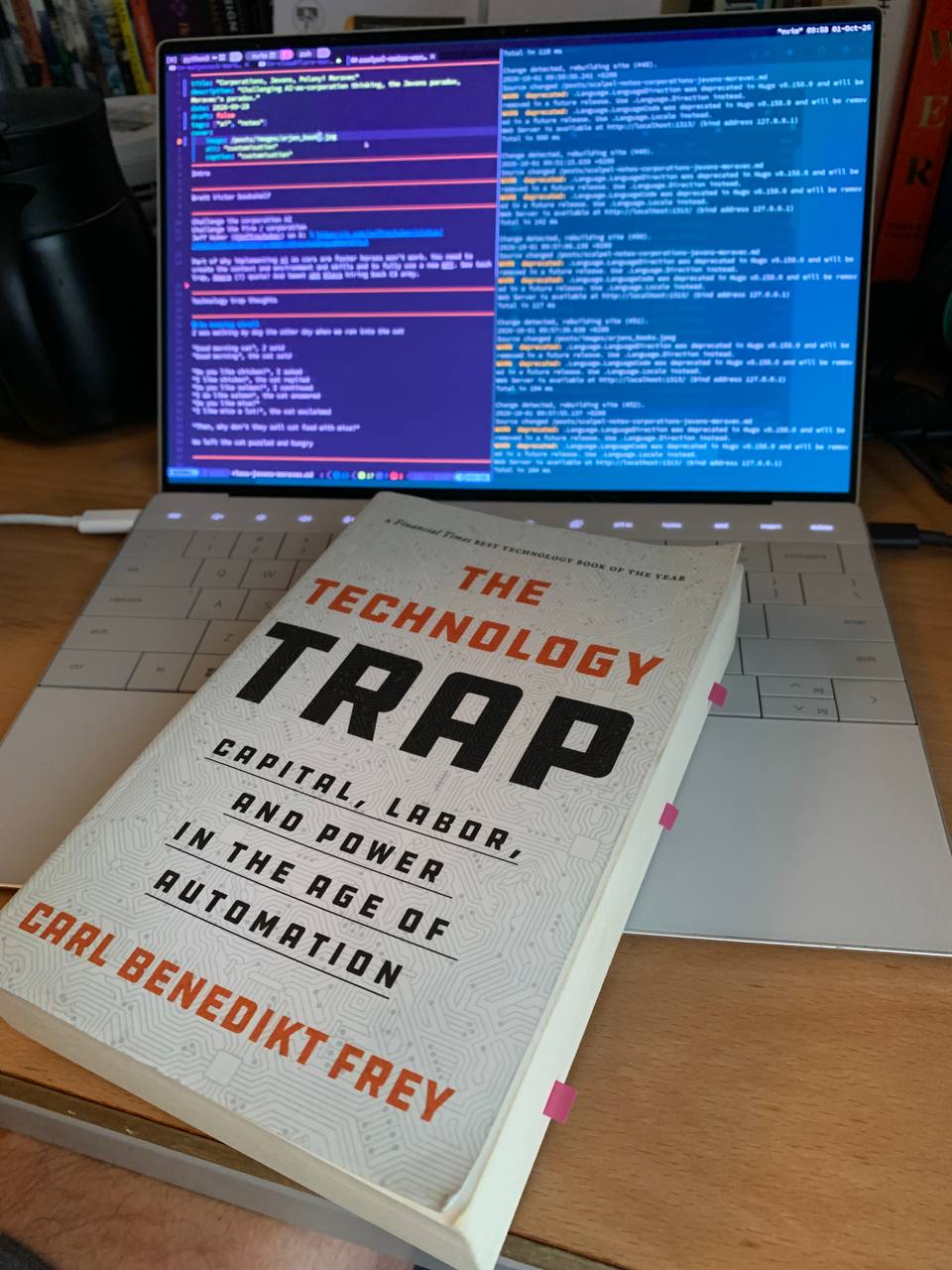 this is a good book
If you would look at environmental supply chain risk service providers from a skeptical perspective, you could say we deliver vanity metrics to the private sector.
That’s not our intention, but that’s how our numbers end up in board rooms, conferences and sustainability reports.
I developed a tool to audit business plans. It triangulates the business plan, roadmap and financial model on inconsistencies and contradictions. For the market, commercial, product, delivery, engineering, partners, organisation and finance indicators, it checks if they are there (Claimed), if there is Evidence backing the claim and if there is follow up (Sequenced). Additionally, there is a module to scan the text for bullshit language (<- I plan to release this as a stand alone tool). It works really well and gives a high level, un-opnionated impression of the structural coherence of the plan.
That made me think about strategy. In most companies, strategy is having strategy sessions, strategy workshops, strategy meetings, the strategic roadmap, strategy documents or “the strategy process”. Strategy is none of that. Strategy is 3 things:
- An idea
- Communication
- Execution
All 3 are equally important. If one or more these points is missing or weak, there is no strategy. Most companies I have worked for, have no strategy. And they don’t even realise. Most common symptoms are:
- too many ideas or idea not focused
- weak, ambiguous communication
- no execution
Usually a combination of the three. All scenarios resulting in no strategy.
The reason for this is lack of decision making and / or weak leadership. After 25 years of working for many organisations, I learned that bad management is not making the wrong decisions. It’s not making decisions. 100 out of 100 times that is not because of lack of competence or vision but because of fear. Decision making is scary. It takes courage. Unambiguous, clear communication about a focused idea and executing on it, is scary. Because you might be wrong.
People are scared because they are not willing, not able to or not wanting to accept all possible outcomes of their decisions. They fear regret. Regret is not being able to accept the outcome of a decision.
To be able to make decisions, you have to be able to accept that you might be wrong, that the outcome is not what you accepted. Else you will be trapped in an endless cycle of doubt, uncertainty and insecurity. Aka fear. And the fear will burn you out.
That logically leads to the following insight: if you want to live a life without regret, you have to be willing, you have to be able, you have to be wanting to accept any possible outcome of your decisions before you make them.
I will write an essay on this titled “Promises, how to build trust, make decisions and live life with no regrets”. I did many stupid things, I made many bad decisions but I do not have regrets.
I thought it was a nice serendipitous find that the Idea, Communication, Execute trio maps elegantly to the Claim, Evidence, Sequenced categories in the business plan analysis; what’s the idea? show me the evidence and what are going to do next? Strategy enforced into the business plan. Again, it’s rare to consistently see strong combinations of the three throughout the plan. Because it means you have to make decisions.
And decisions are scary.