This one is about reading. And about life. La condition humaine.
And a bit about AI and IT.
And also a bit about the EO adoption cycle-curve-graph.
An evening stroll
I was walking my dog the other day when we ran into the bear
“Good morning bear”, I said
“I’m not a bear”, the panda said
“Alles blijft”
“Alles gaat voorbij”
“Alles blijft voorbijgaan”, the panda said
The panda stared into the horizon
Reading
I like reading. I like reading a lot. It’s simultaneously a struggle, rewarding, humbling, mesmerising, depressing, uplifting, meditative, contemplative, isolating, bonding and all the other things take make humans human. I mostly read novels but I also like to read essays, non-fiction or poetry. A lot of writing is about writing itself. Or about being, or rather becoming, an author. That’s where the writing about reading mostly manfifests itself. But I find it often superficial: the author as a child or adolescent loves to read and reads and reads and reads. As if it’s a static, repetitive, automated experience that you can activate and de-activate at will.
That is not how I experience reading. I like it but it’s often a struggle. Especially when starting with a new, unfamiliar author or genre. You have to get ‘into’ their style, their poetica, their themes, their hearts. But once it clicks, it’s mostly very rewarding and you find yourself with a new problem: “I need to read all books of this author!”.
Or I simply ‘forget’ about a book. I read multiple (4 - 6) books simultaneously, all at different paces. It often so happens that I start a book, find another interesting book, start that as well, get hooked, forget about the first book which then might temporarily get lost only to serendipically resurface weeks or months or years later.
I don’t have any set reading hours or pace or structure but I do try to adhere to the rule that once started, a book should be finished. When I’m busy, I read slow. When I’m on holiday I also read slow, but a lot.
My love for reading is also one of the reasons why I love work. Work, or, going to the office. Because that is where other humans are, your colleagues. Some of whom also read. And they always read more interesting stuff than you do so you need to talk to them and ask them what they are reading. Ok, not all of them read interesting stuff. Not even all of them read. But that doesn’t matter. You will find that new colleague that introduces you to that new book by that one new author you never heard of.
So you buy the book.
And so you start reading. Excitedly. And then it doesn’t click. Of course.Of course it doesn’t click. New authors never click for at least the first 20 - 30 pages. You read on, slower and slower, struggling and struggling, feeling embarassed when your colleague kindly informs about the progress (’not yet’, ‘just started’). You want to like it. But you don’t. And your colleague politely stops asking. And you’re wrestling with page 43. Page 43, with it’s mission to never let you arrive at page 44. Page 43 being very successfull in it’s mission.
There’s the book, giving you the finger every night from it’s spot halfway the pile of novels on your bedside table. Day after day, week after week, month after month.
But my bedside pile is patient. And holiday happened and I read Never let me go by Kazuo Ishiguro. I read the final 40 pages sitting on the couch in my living room on a grey Monday morning. I finished the last sentence at 11:34. And I kept sitting on my couch, staring into the grey sky for more than 40 minutes. Thinking about the book, the story, about how it captures being human perfectly.
In the evening, my kid asked if I had a fun book about math. I said, “no, all my books are about life and death and misery and being happy nevertheless”. He rolled his eyes. “But I should have Gödel Escher Bach somewhere”. I dug up the book and gave it to hime. Three minutes later, he gave it back. Too boring.
At night, feeling very motivated for finishing a book and feeling very inspired by Never let me go, I looked at the pile. And Playground smiled at me. I picked it up and (re)started reading. Page 43 was a pushover, page 44 and 45 went down on TKO and before I knew it I was calmly ploughing through page 50, 60, 70, 80, …
AND THEN IT HAPPENED. IT HAPPENED. IT CLICKED.
The chess match is where it clicked. Page 85. The first time the 2 protagonists play a chess match is where it suddenly all made sense. The contradictions, the engineer and the poet. The engineer being obsessed with the mechanics of the game, the poet with the humanity. Both playing with the same fierce intensity. Of course, on page 87, the engineer finds the poet reading Gödel Escher Bach. The book I dug up for my kid just 2 hours before. Of course, they discover the game of Go, a game with simple rules but endless complexity (where did we hear that before?). Of course the book explores themes of capitalism, libertarianism, autonomy, democracy, freedom, information, knowledge, environmentalism via beautifully interwoven story lines.
And of course on page 139, the main character reflects on his dementia: My doctor told me about a thing that dementia patients do called “showtiming”. In denial, embarassment, or terror, they peform themselves in front of other people as if they have no symptoms at all. Perfectly describing the earlier stages of my own fathers 2 year dance with Alzheimers. Dance? Yes, dance. Not struggle, not battle, not fight: dance. He dances with the disease. First he led the disease in an elegant tango of showtiming, charisma and optimism. Fooling us that all was well. Until about a year ago, barely noticeable, the disease took over and started leading him (without him realising) into the inevitable danse macabre, slowly but certainly.
I devoured the rest of the book.
On page 246 the poet turned the engineer on to a thin little book of gnomic aphorisms called Finite and Infite Games by James P. Carse. Finite and Infite games. Where did we hear that before?
Reading is beautiful. You should read as well.
The AI effect
My friend succesfully defended her PhD thesis in anthropology the other day in Leiden University about the tech startup culture in Singapore in the 2010s. I had never been to a PhD defense in Leiden before. It was beautiful, exhilarating and humbling.
While standing in line for congratulating the candidate, I found one of the committee members standing before me. We came to talk about AI and I mentioned my observation about the semantic narrowing of the use of the term AI. She smiled and said, well, what you just described is called the AI effect, you can look it up on WikiPedia.
I did that for you:
The AI effect is the discounting of the behavior of an artificial intelligence program as not “real” intelligence.
The author Pamela McCorduck writes: “It’s part of the history of the field of artificial intelligence that every time somebody figured out how to make a computer do something—play good checkers, solve simple but relatively informal problems—there was a chorus of critics to say, ’that’s not thinking’.”
Researcher Rodney Brooks complains: “Every time we figure out a piece of it, it stops being magical; we say, ‘Oh, that’s just a computation.’”
smalltalk
I can’t do smalltalk. I just can’t. Death and decay are always 1 step away, patiently waiting. I cannot not talk about life.
Tech radar
My favourite twice-yearly opinionated guide to today’s technology landscape recently published their 2025 H2 edition. I didn’t count the blips but it feels like more than half are about AI. Some thoughts:
I like reading “old” IT books and blogs. Partly because it reminds us of how fast developments go. How fast things are absolete. But mostly because there’s also fundamental laws, truths, structures that withstand the wheel of time. Like Joel Spolsky’s blog on leaky abstractions from 2002. Context engineering is a leaky abstraction.
AI is the new Excel, another version of the Jevons Paradox.
Release It!
Not as old as Spolsky’s 00s rambling but 2018 is still already old in tech. Release It! talks about stability being your friend in complex IT systems. Stability is a necessary condition for performance. There’s no point in optimising for performance when your system is not stable. Like consistency and accuracy. Accuracy is a vanity metric when not consistent.
The EO adoption cycle
Aravind dropped another brilliant mental model: the EO Adoption Curve:
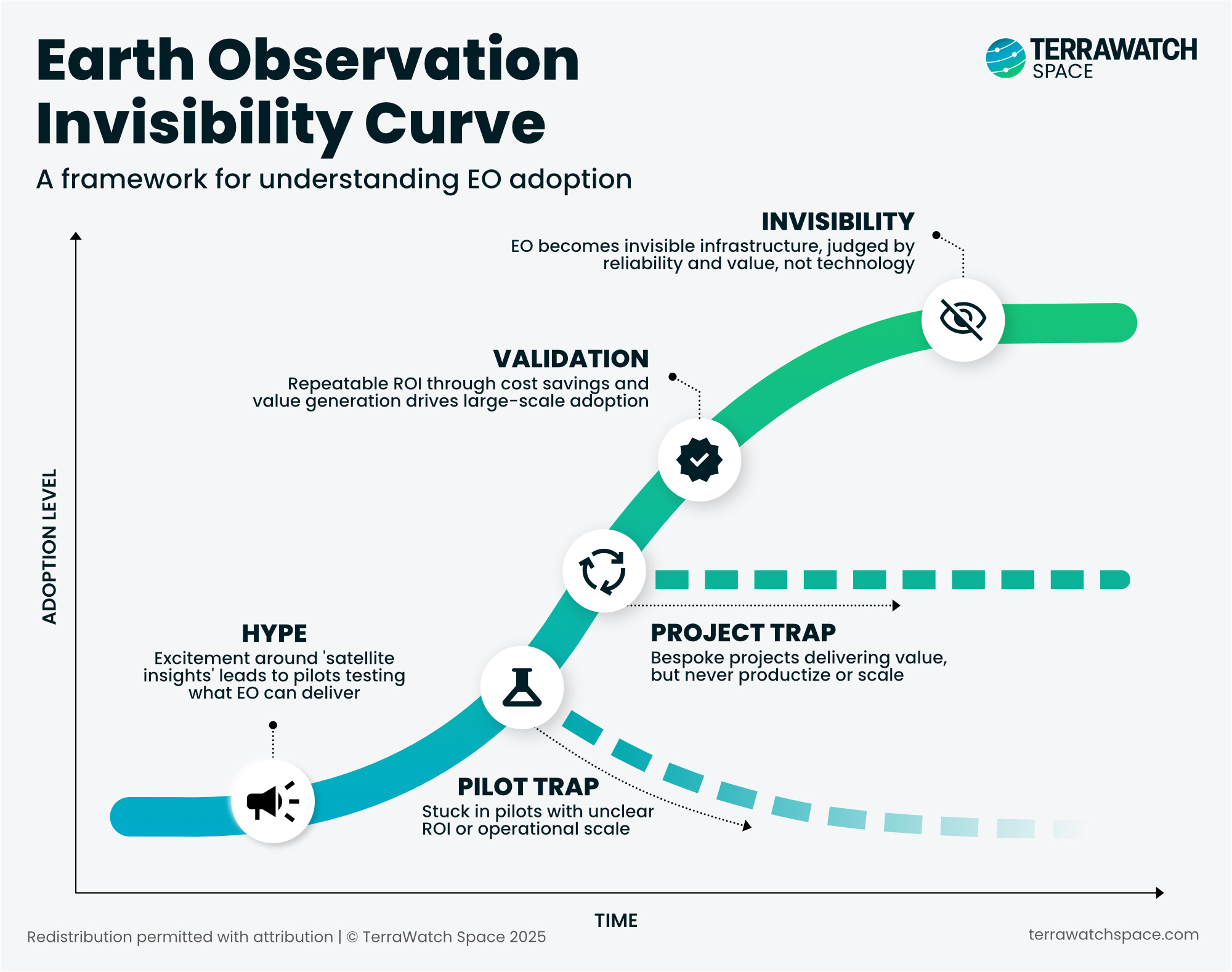
Earth observation doesn’t win when it’s visible - it wins when it disappears.. Reminiscent of Arthur C. Clarke’s 3rd law: Any sufficiently advanced technology is indistinguishable from magic. Arthur C. Clarke’s 3rd law, or, The inverse AI effect.
Or, my own “controversial take on EO”: (y)our clients don’t care about satellites, they want their problems solved.
Einde.